There’s a new software development methodology in town! Meet Frenzy Driven Development (FDD), everyone’s new best friend.
What is FDD? Its founders skipped the ski lodge retreat that produced the Agile Manifesto and wrote their own between back-to-back status meetings:
Manifesto for Frenzy Driven Development
We are uncovering faster ways of looking busy by doing it and demanding others do it yesterday. Through this work we have come to value:
The Thing ™️ senior leaders want right now over the thing they wanted this morning
Tens of projects in parallel over finishing one
Shipped software over software anyone asked for
Responding to the latest executive whim over following any plan, including last week’s
Frenetic activity over thinking
That is, while there is value in the items on the right, we didn’t have time to read them.
I hope none of this sounds familiar to you; if it does, I feel your pain.
The Great AI Psychosis
The promise of a floored 30% software development velocity gain already had the C-suite frothing at the mouth. A 400% performance gain is the latest hype. Just add parallelism to a software factory, and watch your stock transform itself into a golden balloon! 🎈
AWS claims frontier teams get 4.5x productivity gains, sometimes more than 10x. Adam Witanowski saw individual velocity jump 120 to 400 percent with coding agents. GitLab touts a 400% ROI, and Harness reports 4x to 7x more engineering activity.
Look, I get it, the allure is irresistible. I want to automate almost everything if the processes are durable and improve the human outcomes. But there’s more to software development than cranking out code like it’s a deck of cards at a Vegas blackjack table.
When I step back and watch the frenzy unfold, I wonder if this is what the gold rush was like. We’re experiencing a digital gold rush that promises fewer people and infinite automation, which will presumably result in more yachts sitting idly at docks. Go buy stock in yacht companies!
The Bottleneck Moves to the User
The new bottleneck is user acceptance, assuming you want to keep your customers.
The Theory of Constraints is at play, and CTOs and VPs are pissing off stakeholders by telling development teams to push features faster than they can absorb them.
The work still has to pass through design, testing, operations, support, and user acceptance. Faster coding only helps if those parts can absorb the additional output.
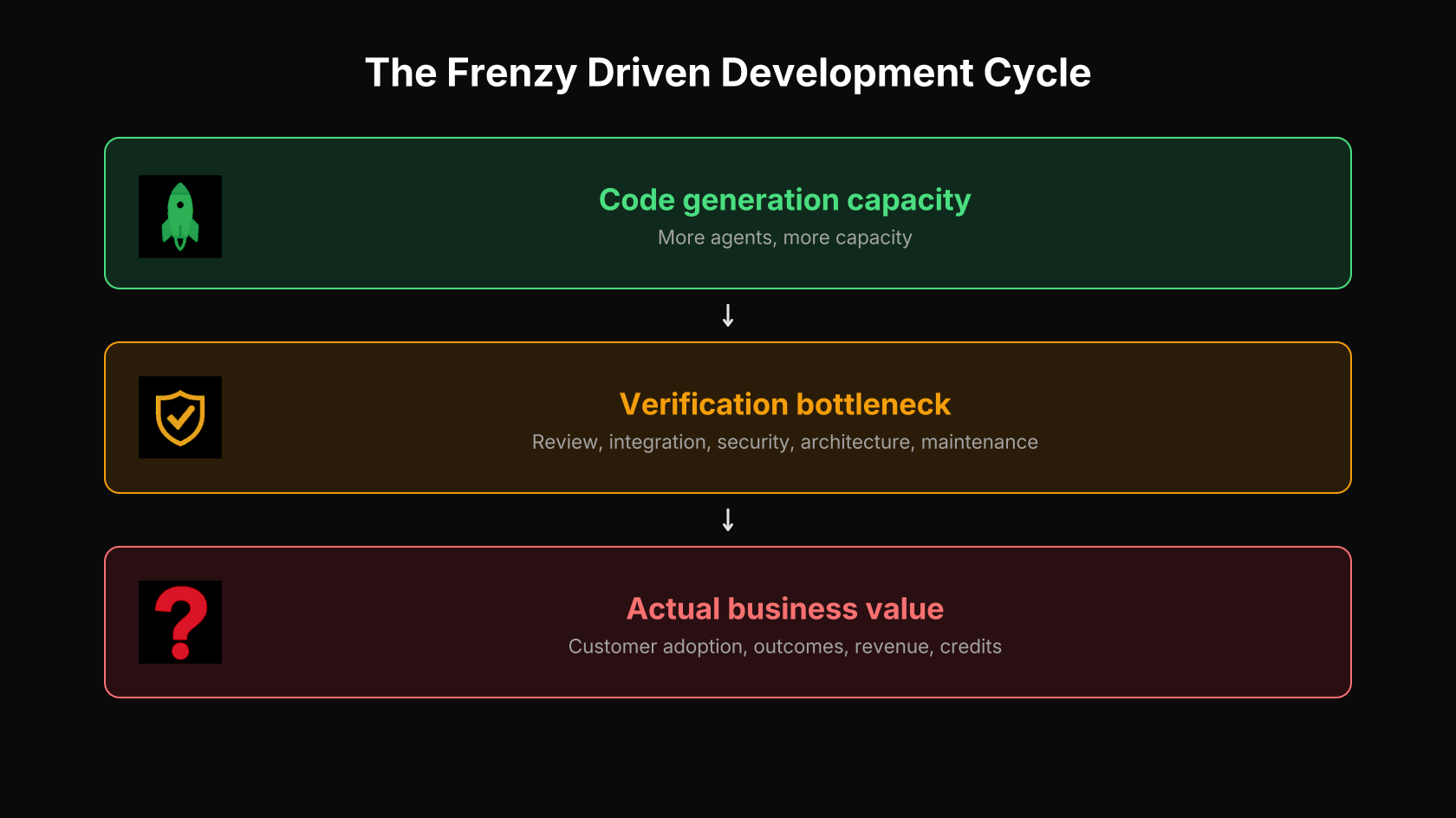
In a talk about software development bottlenecks, Steve Yegge argues that user acceptance becomes the new bottleneck when teams increase delivery speed without improving the rest of the system. The exact bottleneck will vary, but the constraint remains: a system can only process work as quickly as its tightest point allows.
Companies that constantly change systems at maximum velocity are destined to anger their customers. Nobody loves change for change’s sake, and that’s what endless AI agent-powered feature delivery feels like to them.
Speed Needs a Boundary
I love moving fast. I have ADHD; speed is baked into my DNA. However, rapidly jumping from project to project without considering the impact on the broader systems and measuring their business value is nonsensical.
AI is an amplifier. If you’re building the wrong solution for your business, congratulations, you did it faster. 👏
Software developers shipped junk code with questionable quality control before AI came along. If making code right is deprioritized in favor of making it right now, hooray—you’re incurring high-velocity tech debt. 🚀
Slow down to speed up isn’t fashionable in the era of FDD. However, slowing down is required to operate resilient systems.
Conclusion
Frenzy Driven Development is a symptom of the AI psychosis. The C-suite is demanding more, faster, and without regard for the impact on the rest of the system. The bottleneck has moved to user acceptance, and the system is now constrained by its tightest point.
It appears we’re in a holding pattern, and the cycle won’t break until companies run out of money and wake up from the fever dream of replacing software developers with AI. Until then, hold your ground and deliver high-quality, high-impact work as a bulwark against the tide of Frenzy Driven Development mandates.
References
- Manifesto for Agile Software Development, the original this parody borrows from.
- Steve Yegge’s talk about software development bottlenecks.
- What Is the Theory of Constraints?.
- How frontier teams are reinventing AI-native development, Swami Sivasubramanian’s AWS post claiming 4.5x to 10x productivity gains.
- Adam Witanowski on Agentic Maturity Across the SDLC, where individual velocity rose 120 to 400 percent but end-to-end velocity rose only 0 to 40 percent.
- Total Economic Impact Study Finds Organizations Can Achieve 400% ROI with GitLab Duo Agent Platform, a GitLab-commissioned Forrester study measuring financial return, not engineering productivity.
- When Code Stops Being the Bottleneck, Harness’s data on 4x to 7x growth in pull requests, pushes, and CI runs.
Comments #